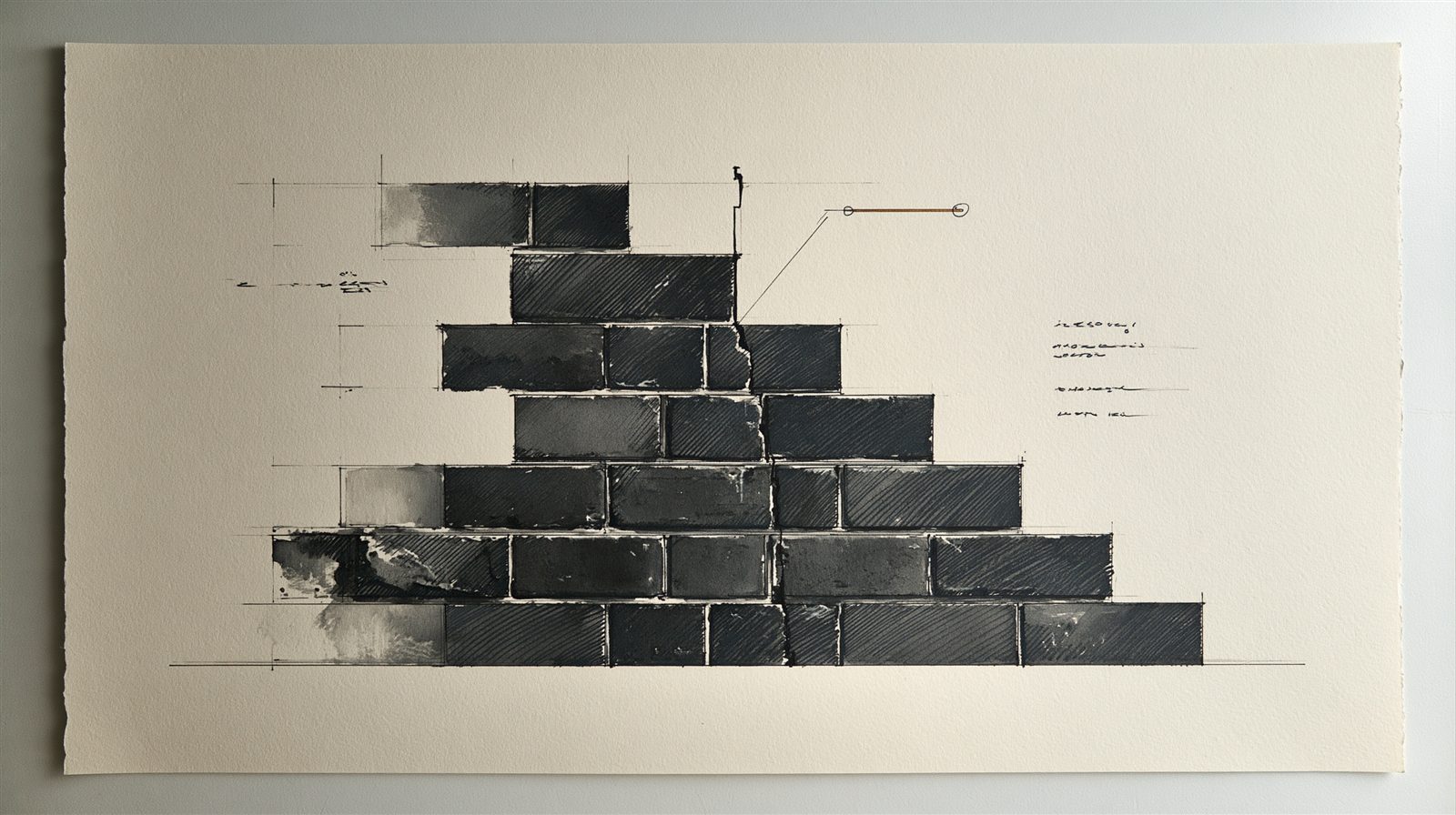
When to Repair, Repoint, or Rebuild a Brick Wall
A brick wall tells you what it needs, if you know how to read it. The decision to repair, repoint, or rebuild a brick wall comes down to what has failed: the face of individual bricks, the mortar joints between them, or the structural integrity of the assembly itself. Each answer calls for a different scope of work, a different material, and a different level of intrusion. Getting that judgment right protects the wall for the life of the building. Getting it wrong accelerates the damage you were trying to stop.
Read the Wall First
Before deciding on scope, look closely.
- Spalling brick faces. When brick surfaces flake, blister, or crumble, moisture has moved into the brick and frozen or cycled through salt crystallization. Often the mortar around it is the cause, not the brick.
- Recessed, cracked, or missing mortar. Joints should be flush with or slightly recessed from the brick face, with a consistent mortar profile. Deep erosion, hairline cracks, or crumbling mortar signals that the joint has lost its role as the sacrificial layer.
- Stepped cracks through joints and bricks. Diagonal cracking that runs through both mortar and brick often points to movement below: foundation settlement, lintel failure, or loss of bearing.
- Bulging or displaced sections. A wall that has bowed outward, separated from adjacent construction, or lost plumb is no longer behaving as a monolithic assembly.
Each pattern points to a different response.
Repair: Targeted Work on Sound Walls
Repair is the right call when the wall is fundamentally intact but has localized damage. Replacing a handful of spalled bricks, resetting a loose sill, or patching a small area of failed mortar falls into this category. The work is surgical. The rest of the wall stays untouched.
Two conditions matter here. First, the replacement brick has to match the original in size, density, and porosity. Modern high-fired brick set next to soft historic brick will drive moisture into the older units and accelerate their decay. Second, any new mortar has to be compatible with the surrounding assembly. In older Charleston walls, that almost always means a lime-based mix, not a Portland-heavy one.
When to Repoint a Brick Wall
Repointing addresses the joints. When mortar has eroded a quarter inch or more below the brick face, cracked through, or lost cohesion, the joint can no longer shed water or accommodate the small movements that every wall experiences. At that point the bricks themselves start to take on the stress and moisture the joint was supposed to manage.
Proper repointing is slow, careful work. Old mortar is cut out by hand to a depth of roughly two to two and a half times the joint width, the cavity is cleaned, and new mortar is packed in tight lifts. The mortar profile is tooled to match the original. On historic Charleston brick, the mortar mix should be softer than the brick. A lime cure takes weeks, and vapor permeability of the finished joint has to allow the wall to breathe. Portland-rich mortars trap moisture behind the brick face, and the brick spalls instead of the mortar wearing.
If you have a large area of failed joints on an otherwise sound wall, this is usually where you land. For a deeper look at the process on historic assemblies, see our historic brick repointing work in Charleston.
Rebuild: When the Assembly Has Failed
Rebuilding is the last option, and sometimes the only honest one. Consider it when:
- A wall section has bowed, leaned, or separated from the structure it once tied into.
- Cracking runs through both brick and mortar in patterns that suggest ongoing movement.
- The substrate behind the brick, whether a wythe of soft brick, a wood frame, or a foundation, has failed.
- Prior repairs with incompatible materials have caused the original brick to deteriorate beyond salvage.
A rebuild does not always mean demolishing the whole wall. Often it means carefully dismantling a defined section, salvaging every sound brick, correcting the underlying cause, and relaying with matched materials. Done well, a rebuilt section is invisible against the original. Done poorly, it stands out for a century.
The judgment call between aggressive repointing and a partial rebuild depends on site conditions. An honest assessment on site, with the wall opened up in a few discreet locations, is often the only way to know.
Why This Matters in Charleston
Charleston’s walls live in a hard environment. High humidity, salt air, driving rain from the coast, and daily temperature swings all push moisture in and out of masonry. Many of the peninsula’s historic walls were built with soft, hand-made brick and lime mortar, an assembly designed to move moisture outward through the joints. When those walls were later repaired with hard Portland mortar or sealed with modern coatings, moisture found another way out: through the face of the brick.
The result is the spalling you see on so many older facades. The fix is rarely more sealer or harder mortar. It is usually removing the incompatible material and returning the wall to a material-correct assembly that lets it dry the way it was designed to.
Any work on a historic property in Charleston may involve review by local preservation authorities. Confirm the requirements for your specific property before beginning work.
When to Call a Specialist
Some situations warrant a specialist rather than a general contractor:
- The wall is on a historic structure or in a regulated district.
- You see active movement, fresh cracking, or displacement.
- Previous repairs used mortar that looks harder or grayer than the original.
- Spalling is widespread across a facade, not just at ground level or under a leaking gutter.
- The wall carries structural load and shows any sign of distress.
In these cases, a specialist can assess the assembly, identify the underlying cause, and scope the work at the right level, whether that is repair, repointing, or a targeted rebuild.
Request a Project Review
If you are weighing whether to repair, repoint, or rebuild a brick wall on your Charleston property, we can walk the wall with you and give you a considered read. Request a project review to start the conversation.