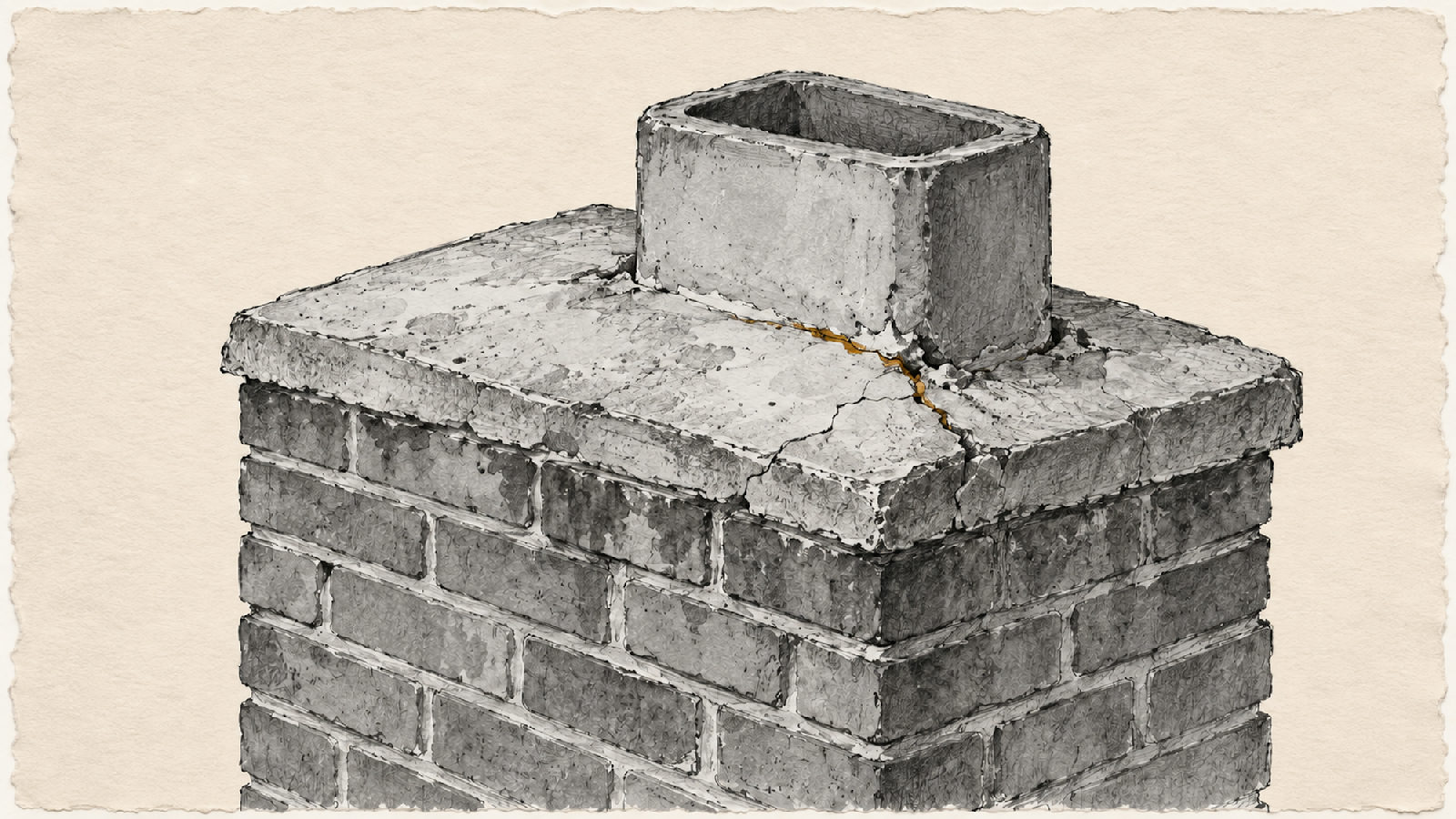
A call about several problems in a brick chimney can lead back to a small area at the top. The field note behind this article describes a failing cap allowing water into the upper masonry at multiple points. That is the starting condition, not a complete inspection record. The precise entry paths, material composition, and repair limits still need to be established on site.
For a Charleston property owner, the useful question is what must change so the same wetting pattern does not return. A neat patch over the most visible crack may leave the surrounding problem untouched. The repair needs to account for the crown, the flue junction, the brickwork, and the roof connection together.
Start by identifying the part that failed
People use cap to describe several different chimney components. Here, the subject is the crown: the surface covering the top of the masonry around the flue. A metal rain hood above the flue serves a different purpose. Replacing that hood does not automatically correct cracks in the crown below it.
The phrase Portland cap also needs care. It may describe a cement-rich mortar wash, a concrete crown, or an earlier patch whose ingredients are unknown. Appearance alone cannot establish the mix. Portland cement is not, by itself, proof of an unsuitable crown. The investigation must distinguish the material used from the way the assembly was detailed and built.
Record whether the crown is intact or fragmented, where it separates from adjoining materials, and whether previous repairs cover the same locations. These observations help distinguish a localized defect from an assembly that needs replacement.
Read the water path before choosing a repair
Begin with photographs of all accessible faces, the top, and the roof intersection. Note where deterioration is concentrated and ask when interior dampness appears. A report that leakage follows wind-driven rain from one direction gives a different starting point from staining that remains unchanged through dry weather.
Keep the initial questions practical:
- Does the crown have visible cracks or loose edges?
- Is the joint around the flue open or repeatedly patched?
- Are the upper brick courses loose, deteriorated, or previously rebuilt?
- Does the roof flashing have visible discontinuities?
- What has already been repaired, and did the symptom change afterward?
These are inspection questions, not findings about this particular chimney. White deposits or dark staining can help identify areas to investigate, but a photograph does not prove the source of the water. Where several entry routes remain plausible, separate them in the assessment instead of assigning every symptom to the first visible crack.
Crown cracks and the flue joint
A crown must shed water while accommodating movement at adjoining materials. A thin feathered edge and a rigid junction around the flue deserve close attention. Adding another thin layer over an unstable base may reproduce the same weakness.
The Brick Industry Association’s residential chimney guidance describes crown geometry that includes substantial edges, projection beyond the masonry, and detailing for movement. Its details are useful technical background, not a substitute for a repair design matched to an existing historic chimney.
For this type of investigation, request a repair description that explains the proposed slope, edge, drip, and flue junction. The description should also say what remains uncertain until the failed material is removed. A coating name alone does not explain how the water will leave the assembly.
What the upper brickwork can reveal
Once access is available, compare the top courses with the masonry below. Record missing mortar, loose units, surface loss, and earlier patches separately. A sound brick with a deteriorated joint needs a different response from a fractured or unstable unit. Avoid expanding the replacement scope merely to make old work look uniformly new.
Mortar selection matters when the chimney includes historic brick. National Park Service Preservation Brief 2 treats compatibility as a combination of material properties, including permeability and strength. A replacement mortar should not be selected simply because it is harder. Moisture and salt movement can damage masonry when the repair changes how the assembly dries.
Match the repair approach to the material that is actually present. Where the existing mortar or brick varies, keep those differences in the record. A trial area can help establish joint appearance and workmanship before a larger area is committed to the same treatment.
Include flashing in the diagnosis
The crown is only one part of the water-management system. Roof-to-chimney flashing and concealed crown flashing may also require investigation. The Brick Industry Association’s chimney flashing guidance emphasizes continuity, appropriate laps, and an outward drainage path. A break in that path can leave water entering behind an apparently repaired surface.
The practical implication is coordination. A masonry repair and a roofing repair should have a clear boundary of responsibility. Record who will inspect the junction, who will complete any associated work, and what condition must be verified before access equipment is removed. Otherwise, each trade may finish its visible work while an unresolved junction remains between them.
Set the scope around verified conditions
A useful repair scope separates confirmed work from allowances for concealed damage. It identifies the crown work, selective masonry repairs, related flashing work, and any specialist assessment of the flue. It also establishes a pause for review if removal reveals more deterioration than the initial inspection could show.
For an older Charleston building, preserve the existing chimney profile and sound masonry wherever the repair permits. Check whether exterior changes need local review before altering the visible form. Do not let an illustrative sketch become an assumed construction detail or an unapproved change in appearance.
Document the repaired areas from repeatable viewpoints. Agree on follow-up observations after rainfall and record any continuing symptoms. That gives the owner and contractor a common basis for deciding whether the work addressed the original complaint or whether another source still requires attention.
When to call a specialist
Arrange an assessment when a crown is breaking apart, upper brickwork is loose, or leakage returns after patching. Avoid climbing onto the roof to test suspect masonry. If damage may affect the flue or safe operation, have a qualified chimney professional assess the system before using it.
Our historic brick repointing and masonry restoration service provides the starting point for reviewing the masonry condition and an appropriate repair scope. Send existing photographs and a short description of when the symptoms appear. The next decision should follow the condition that can be verified.