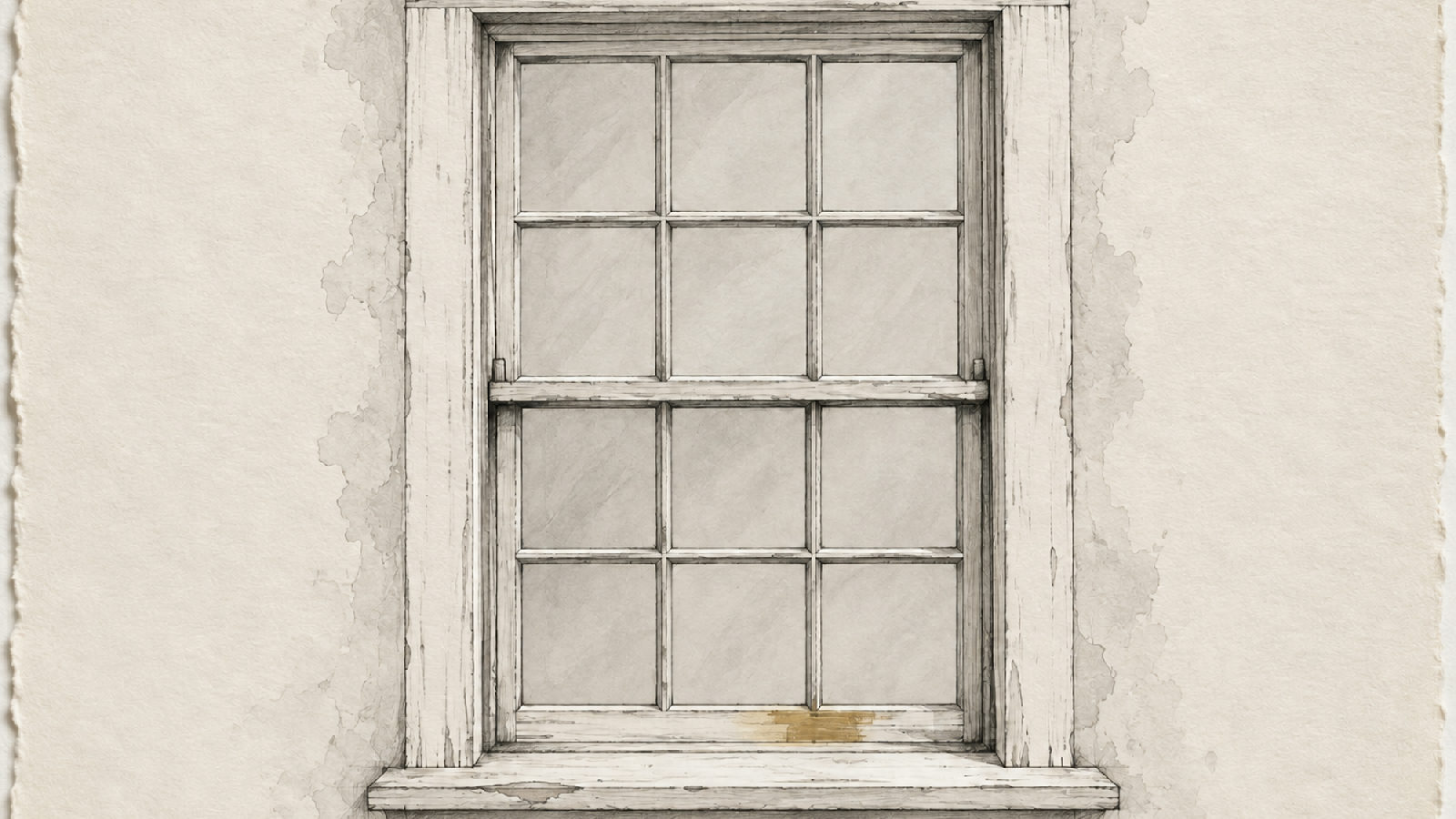
A window that sticks, rattles or has peeling paint may need work. Those symptoms do not, by themselves, establish that the entire window needs replacement.
For owners considering historic wood window repair in Charleston, the first useful step is a condition assessment that separates the parts of the window and explains what each needs. A repairable sash, a damaged sill and loose glazing are different findings. They should lead to a considered scope rather than a single assumption about every opening in the house.
Look at the window as an assembly
A traditional double-hung wood window contains a frame, sill, moving sash, glass, glazing material and operating hardware. The sash itself has rails, stiles and often narrow muntins dividing the panes.
The National Park Service’s Preservation Brief 9 recommends evaluating windows individually and recording the condition of their components. It also cautions against interpreting failed paint as proof that the underlying wood is beyond repair.
Ask the assessor to identify the affected component and describe the evidence. “Bad window” is not a useful repair instruction. A finding that the glazing needs attention while the sash remains sound gives the project team a more precise starting point.
For a buyer, distinguish a preliminary observation from a completed assessment. An inspection photograph may justify further investigation without establishing the eventual scope.
Prepare a record the repair team can use
Before the visit, gather photographs and any known history. Note which windows are difficult to operate, which show water-related changes and which have received previous work. Do not force a stuck sash or disturb loose glass to demonstrate the problem.
A simple location system makes follow-up easier. Identify each opening consistently in the notes and photographs. Keep an overall view of the window as well as close views of the concern.
Ask the assessment to distinguish:
- Maintenance and adjustment needs.
- Glazing or hardware work.
- Localized timber repair.
- Replacement of a particular component.
- A recommendation for complete replacement, with its basis.
Leave room for uncertainty where paint or inaccessible construction prevents a firm conclusion. The record should explain what further inspection is proposed and who will authorize it.
This is particularly useful when several trades or a property manager are involved. Everyone should be able to identify the same opening and understand the current recommendation.
Address why the deterioration occurred
Repair planning should include the conditions that allowed damage to develop. NPS identifies moisture as a major contributor to timber deterioration and draws attention to glazing, joints and the sill’s ability to shed water.
Ask where water is entering or collecting and how that finding will be addressed. A proposed timber repair should be considered alongside the surrounding wall and drainage details where those are implicated.
Avoid accepting “old age” as the whole explanation. Equally, do not assume every discolored area represents deep decay. Request a description of the condition found and the limits of the assessment.
For a Lowcountry property, make sure access and weather protection are part of the discussion. If sash will be removed for work, identify how the opening will be secured and protected, who is responsible for it, and when the window is expected to return.
Use a sample repair to resolve uncertainty
A representative repair can show what retention involves before a wider program is approved. The NPS guidance on evaluating historic windows identifies sample repairs as a useful way to answer questions about feasibility and quality.
Choose the sample for a reason. A straightforward window may demonstrate finish quality, while an opening with the disputed condition may be more useful for testing the proposed repair approach. Record what the sample is intended to establish.
At review, ask to see the completed work operate. Discuss the appearance, the fit of repaired components, the treatment of retained glass and the remaining maintenance needs. Where a specific performance level matters, determine whether appropriate testing is needed rather than relying on appearance alone.
Keep the accepted sample and its record as the reference for similar work. If another opening reveals substantially different damage, revisit its scope rather than treating the sample as a guarantee that every window is identical.
Compare a repair scope with a replacement scope
A fair comparison needs both proposals to describe the result. Ask what material will remain, what will be replaced and which related work is included.
For repair, the scope should identify the components to be treated and any assumptions about concealed conditions. For replacement, ask how the proposed unit relates to the existing opening, frame, glass pattern, profiles and surrounding trim.
The NPS evaluation guidance places the condition and significance of the existing windows at the center of the decision. It also recognizes that requirements such as operation, energy performance and severe-weather provisions need consideration alongside deterioration.
Avoid assuming that a new unit resolves every project requirement or that retaining an old window answers every performance concern. Define the actual requirements, then have the project team assess the options against them.
Include room access, protection, finishing and cleanup in both scopes. This keeps the decision focused on the complete work rather than two incomplete descriptions.
Confirm the review path before ordering
For a Charleston property, check the applicable preservation and permit requirements before committing to replacement units. The City’s applications and guidelines page lists window replacement and repair application routes, while its BAR information explains the role of preservation review.
Ask what documentation is needed for the specific property and proposed treatment. A manufacturer’s product sheet can describe a new window, but it does not document why an existing historic unit cannot be retained.
Keep the condition record, photographs, proposed treatment and any required approval together. Resolve that sequence before fabrication or removal, particularly when a decision may affect historic material.
Plan painted-surface work and maintenance
Old painted windows need careful handling when work will disturb coatings. The EPA’s lead-safe renovation guidance identifies lead concerns in pre-1978 housing and explains precautions for work that creates paint dust. Confirm the appropriate assessment, work practices and qualified personnel before preparation begins.
At completion, request a concise maintenance record. Include products used, any relevant care instructions, photographs of repaired areas and items to watch during later inspections. Agree who will receive that information when the property is managed by someone other than the owner.
When to call a specialist
Call a preservation specialist when operation is difficult, glazing is loose, timber deterioration is suspected or replacement has been proposed without a component assessment.
CBC’s historic preservation and renovation service can help organize that evaluation. Begin with documented conditions, test a representative repair where useful, and decide how much of the existing window can responsibly remain.